Prayer as the Ground of Action: Contemplation, Justice, and the World - Lesson Four
This month’s learning includes:
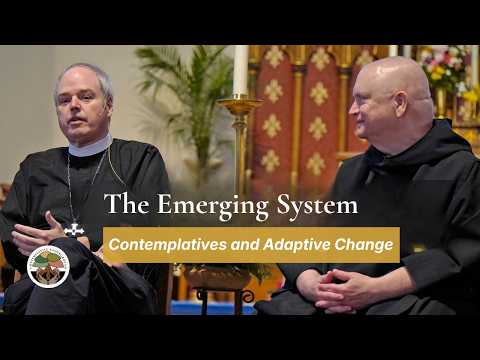
• An 8-minute video reflection - Watch part of a conversation between Brother James Dowd and Episcopal Church Presiding Bishop Sean Rowe on the importance of this movement.
• A simple contemplative practice (one minute of intentional silence)
• Reflection questions for individual or shared use
This month’s learning may be engaged individually, in small groups, or within leadership settings. If you’re looking for a way to practice contemplation with others, this learning also connects directly to our ongoing live sits.
Explore the Month 4 course materials here. Use them as part of your personal faith study or with community groups, vestries, or Sunday school classes.
Come as you are. Begin simply. And, you are always welcome to join our Centering Prayer sits. View the schedule.
View the transcript of this video below, lightly edited for clarity and flow for reading:
I'm hoping to promote this and talk about it — to see what emerges in the church. As I go around the church, I keep having more and more conversations like this. That tells me something.
It doesn't mean that everyone is going to become a contemplative. And I think there's something that comes with life experience, with ministry experience. I don't need a 25-year-old to be the same as a 50-year-old. First of all, they can't be.
I can only speak out of my own journey at this point. When I was 25, I was like, "Okay, how about you people sit in a circle and pray and I'll go actually get something done." You know, go ahead — look at the candle. I know you came out of the womb differently. But I was just like, "Yeah, whatever. I'll do that once a week when I have time, but I've got to go. There's a world that needs change, and this isn't going to change it."
The fact is, you kind of need both. Maybe you don't need someone quite as flip about it as I was — but you have a whole community for a reason. People at different levels of formation. I had older spiritual mentors who were able to hold that tension with me, who were able to live with that kind of young arrogance and help me along the way to a point where it was able to mean more to me.
So I think yes — there's a way in which, institutionally, we can begin to lift this up. To say this whole journey is important, and to bring all of the experience to bear, because I think it's about the whole community. Something like beginning to emphasize it and say, this is where it is — our tradition speaks to that.
Every major social change we've seen has come out of that way. It has come out of that level of centeredness, and that ability to see with different eyes.
Br. James Dowd, OSB
We absolutely don't need everyone running around sitting on top of mountains. Because of the Roman Catholic formation I had as a young person — in the post-Vatican 2 era, at what I think was their high point — they were so good at blending, at even marrying, social justice work with the contemplative tradition. These are not separate things.
There are certainly going to be people who are better at one or the other, or who prefer one more than the other. That's all pretty standard. But for me, this seeming separation of the two doesn't make a whole lot of sense.
There's also evolution in everyone's spiritual journey. I know people who have evolved the other way — much more contemplative when they were young, much more active when they got older. It's all God's calling.
The whole idea of your story blending in with the story of your time and your place — all of that comes, for me, from Oscar Romero. He really worked hard in those few short years he had as archbishop to explain to his people that our story is the history we're going to be called to account for.
We don't have to worry about how it was in the 2010s, much less the 1950s. And we don't have to worry about what it's going to be like in the 2040s or 50s or 60s. Those of us who get there — great. Worry about that then.
We have to worry about now. This is our history. This, happening in front of us — the salvation that St. Paul calls us to work out — it's here, and it's now.
Br. James Dowd, OSB
I really believe in the power of prayer. I believe in a lot of other kinds of power that the Christian community can have — like action, and how we engage that as a community. But prayer has the ability to change the world. I'm not making this up. It's Jesus who says, "You want to move a mountain? Go ahead and pray."
I often use the example of Jesus, in which we rarely actually know what he did. But when he goes off to pray — all those times throughout the gospels — he's going up on a mountain, out on the lake, into a hidden place, and finally into the garden of Gethsemane, where we do have some sense of what he prayed. All of those are examples of sometimes we just need to pull back, quiet ourselves down, and allow that prayer to happen.
But what does he always do? He always gets called back into action — teaching, healing, preaching, and finally, willingly going to his arrest and to his death.
And there's still something about that — when I look at Jesus's prayer life, what I can draw from the gospel accounts is enough for me to say: if Jesus is doing that, maybe we should shut up and be quiet and pray a little bit.
There are two things I know I am trying to work on, and want the church to do as a whole: spiritual formation and building community. When you put those together — that's the way you really get formed spiritually. Classes are great, they really are. But the way you actually get formed is by praying. You have to do that. And when we do that together, we are that much more powerful — in the best sense of that word.
Presiding Bishop Sean Rowe
Ultimately, I believe the gospel of Jesus Christ is a matter of life and death for the world — and we, as a church, are the risen body of Christ in the world. So it is incumbent upon us to engage these practices and live this way. It's that important. It's a matter of life and death for the world.